
Fossils and Quarrying Activity: The Case Study of the "lastame" in the Lessini Mountains

In Italy, when dealing with cultural heritage, fossils are among the most "neglected" assets, also due to some legal issues: on the one hand, unauthorized fossil collection is prohibited, but on the other hand, the extraction of rocks that may contain these remains is allowed.
However, given the lack of a specific framework for the conservation of fossils, quarry workers are not incentivized to contact authorities or paleontologists when they find valuable remains, for fear of interrupting excavation activities.
A recent study led by the Department of Geosciences at the University of Padua and carried out in collaboration with the University of Vienna and the University of Modena-Reggio Emilia, focused on the Lessini Mountains in the province of Verona, a unique area that holds important fossils of marine vertebrates and invertebrates from northern Italy.
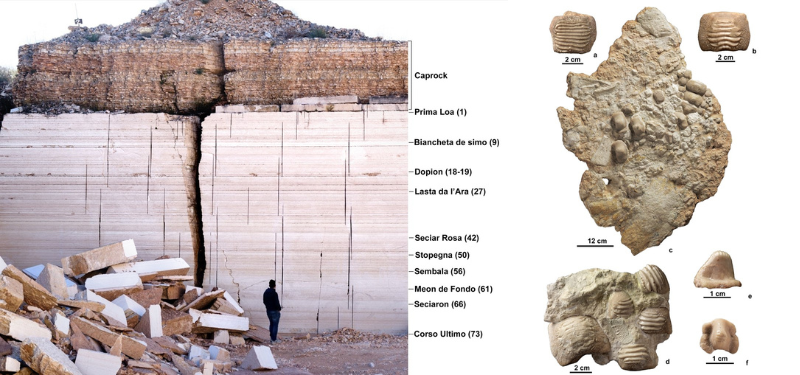
Here, particularly in the locality of Sant'Anna d'Alfaedo, numerous quarries are active, extracting a typical building stone, locally called "lastame". From a geological point of view, this stone belongs to the Scaglia Rossa formation, dating back to the Late Cretaceous period. These limestones formed in a relatively deep marine environment and preserve numerous fossils within: in addition to a large number of invertebrates, sometimes of great scientific value, remains of large marine vertebrates have been more rarely found.
The research, published in Geoheritage, proposes the first risk assessment for a paleontological site in the Veneto region. Greater collaboration between paleontologists and quarry workers, the researchers emphasize, could allow for the recovery of extremely important remains and promote a new kind of geotourism for these areas.
"In this study, focused on the stone quarries of Lessinia, we provided an overview of these sites, which are important extraction centers for ornamental stones, but at the same time, these are localities that the Ministry of Culture has included in the list of paleontological sites of national interest", explains Pietro Calzoni, a PhD student at the Department of Geosciences at the University of Padua and first author of the research.
For the Department of Geosciences, Prof. Luca Giusberti and researcher Dr. Jacopo Amalfitano also participated in the research.
PRESS INFORMATION:
PAPER: How Excavation Activity is both a Blessing and a Curse for the Palaeontological Heritage: The Case Study of the Fossils from the "Lastame" in the Verona Province (Northern Italy), Geoheritage 17, 141 (2025).
AUTHORS: Pietro Calzoni, Manuel Amadori, Jacopo Amalfitano, Guido Roghi, Giovanni Serafini, Franco Zivelonghi, Roberto Zorzin, Luca Giusberti
DOI: https://link.springer.com/article/10.1007/s12371-025-01184-4