


How suspended sediments and river dynamics have changed in the Po River over the last 100 years
Rivers are dynamic systems essential for the environment, the economy, and society: they transport sediments, shape landscapes, sustain ecosystems, and feed deltas and floodplains. Understanding how human activities affect river dynamics is therefore crucial to ensuring sustainable management of water and sediment resources.
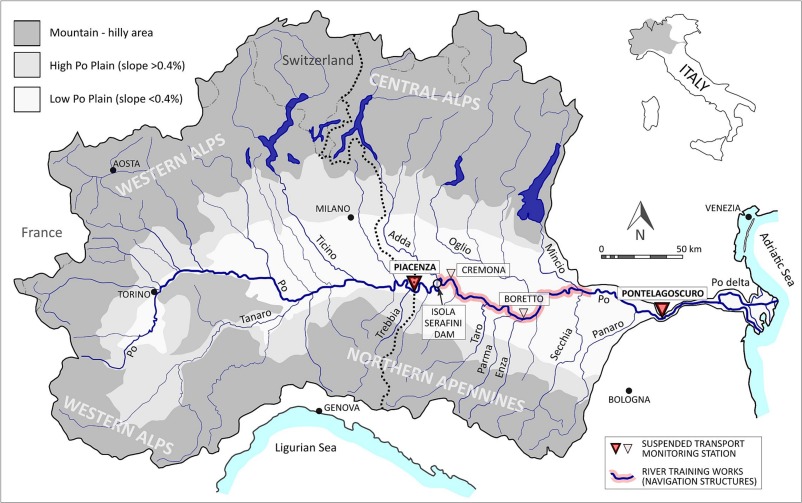
A new study by the Department of Geosciences, University of Padua, in collaboration with the University of Milan, analyzes how a series of human interventions has profoundly altered suspended sediment transport in the Po River, Italy’s largest fluvial system, over the past 100 years.
By integrating long-term data on suspended sediment transport with a detailed analysis of major anthropogenic drivers—including land-use changes, in-channel mining, dam construction, and river engineering works—the researchers reconstructed the spatiotemporal trajectory of sediment dynamics along the entire river system.
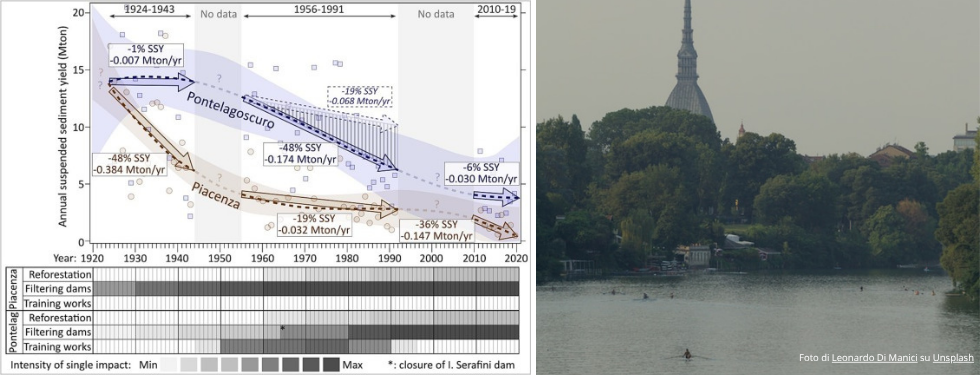
The results reveal a marked decline in sediment yields, occurring asynchronously along the river. Between the 1920s and 1940s, the most significant reductions, around 48%, were observed in the middle course of the river, primarily due to dam construction in the western catchment. During the 1950s–1980s, similar decreases affected the lower course of the Po, influenced by river training works, sediment deposition within the active channel, and the presence of flood detention basins along the Apennine tributaries. Considering the entire period from 1924 to 2019, the Po experienced an overall reduction in annual sediment yields exceeding 72%, contributing to significant geomorphological transformations in the Po Delta and raising questions about its future evolution.
"It has long been known that suspended sediment transport in the Po River, as in many other rivers, has undergone major alterations. In this study, we not only aimed to quantify accurately how much suspended sediment transport has declined over the past 100 years, but also to identify the various factors—mainly of anthropogenic origin, including dam construction and river training works—that have led to such a drastic decrease," explains Prof. Nicola Surian, Head of the Department of Geosciences and co-author of the study.
"The results of this study, conducted in collaboration with the Po River Basin Authority, have strong relevance for river management, particularly at a time when efforts are being made to restore natural fluvial processes and dynamics where feasible. A revised approach to managing river sediments could become a key tool for the Po Delta, undoubtedly one of the most vulnerable areas within this river system”, Prof. Surian points out.
This research is part of the “Geosciences for Sustainable Development” Project, conducted by the Department of Geosciences at the University of Padua, and funded by the MUR within the framework of the Dipartimenti di Eccellenza 2023–2027 program.
PRESS INFORMATION:
Brenna, A., Bizzi, S., Surian, N. (2026)
The great decline of suspended sediment load in the Po River (Italy) over the last 100 years.
CATENA, 265, 109864.